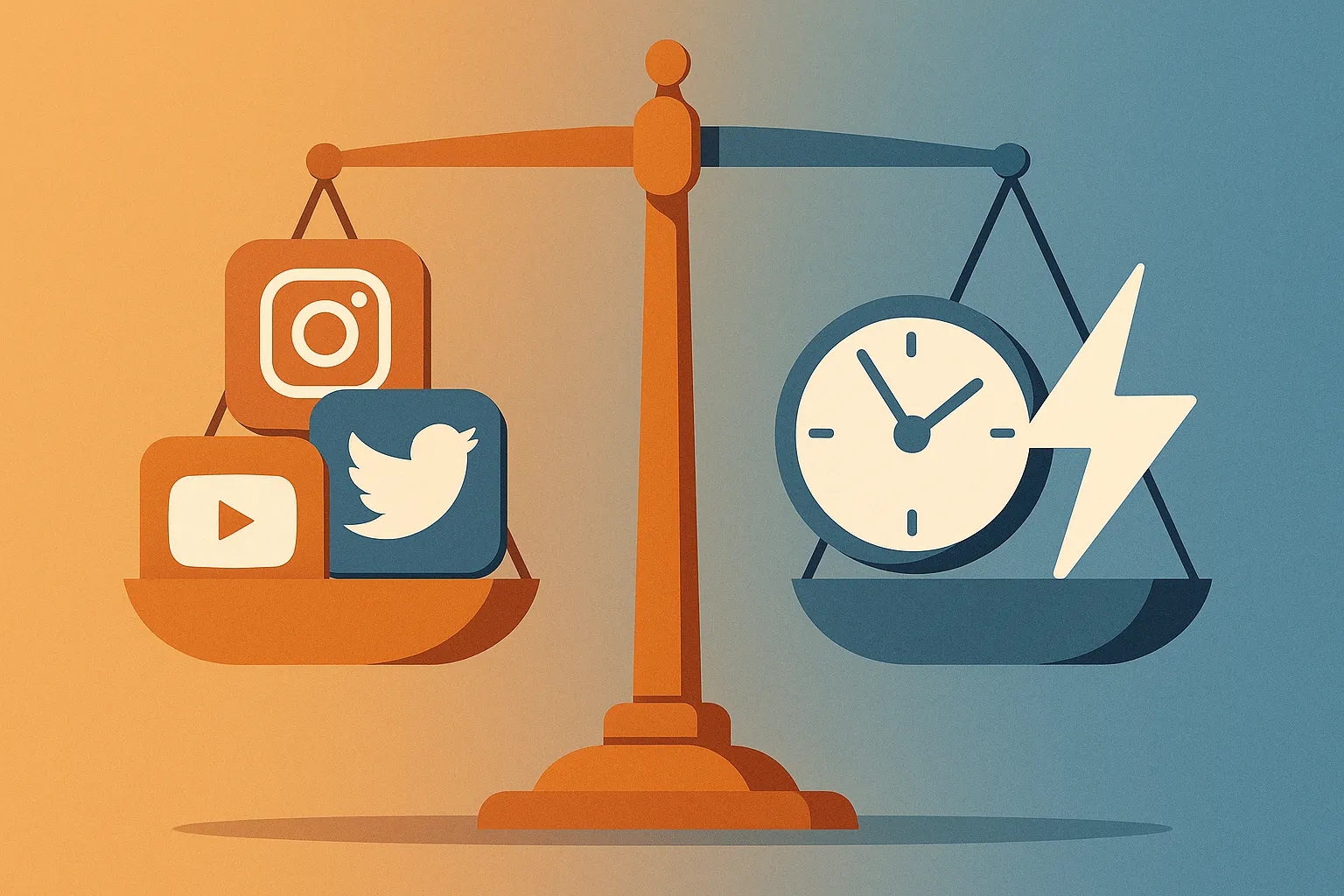
So someone on Twitter told me cross-posting is "killing their reach" and I almost spit out my coffee. Not because they were wrong — maybe it was hurting their reach. But the way people talk about cross-posting, you'd think it's this binary thing. Either it's the holy grail of content strategy or it's the lazy path to algorithmic death. Neither of those takes is right, and honestly I'm tired of seeing the same debate play out without anyone giving a nuanced answer.
Here's what I actually want to answer in this post: is cross-posting on social media worth the effort in 2026? Not in theory, not according to some marketing textbook, but in the real world where you've got limited time, limited energy, and like six different apps demanding content from you every single day. I'm going to give you my honest take — the good parts, the bad parts, and the stuff nobody mentions because it doesn't fit neatly into a listicle.
Fair warning: this isn't going to be one of those posts that ends with "it depends!" and leaves you exactly where you started. I have actual opinions. You might disagree with some of them. That's fine.
Key Takeaways
- Cross-posting is worth it for the vast majority of creators and businesses — the time savings alone make it a no-brainer, even if the engagement per post is slightly lower than fully native content.
- The "engagement penalty" is real but smaller than people think — well-adapted cross-posts typically perform within 10-15% of native content, which is a trade-off most people should take.
- The real risk isn't engagement loss, it's laziness creep — cross-posting becomes harmful when it makes you stop caring about adaptation, engagement, and platform culture.
- Not cross-posting is almost always worse than cross-posting — inactive platforms hurt your brand more than cross-posted content ever could.
- The ROI calculation favors cross-posting overwhelmingly — 85% of the results at 30% of the time investment is a deal you should take every single time.
- Tools have made the process so easy that the "should I?" question is almost irrelevant — the setup cost is trivial and the time savings are immediate.
The Case FOR Cross-Posting
Let's start with why I think cross-posting is worth it for most people. And I want to be specific here — not vague marketing-speak, but the actual concrete reasons that matter in daily practice.
Does Cross-Posting Actually Save Meaningful Time?
The short answer is yes, and it's not even close. Let me lay out the math because I think alot of people underestimate the time differential.
Say you post one piece of content per day to 6 platforms. Without cross-posting, each piece of content needs to be individually uploaded, captioned, and published on each platform. Even if your fast — let's say 4 minutes per platform — that's 24 minutes per day just on distribution. Over a week, that's almost 3 hours. Over a month, 12 hours. Over a year, 144 hours. That's 18 full working days spent doing nothing but uploading the same video to different apps.
With a cross-posting tool, that same process takes about 5-7 minutes total. Upload once, write your adapted captions, select platforms, schedule, done. You've just saved yourself 17 minutes per day, or roughly 100 hours per year.
Now, those 100 hours don't sound dramatic on a daily basis. But think about what you could build with 100 extra hours. A course. A product. Deeper community engagement. Better content. Or just, you know, not burning out. That last one is underrated. If you want to see the full breakdown of what you can automate and what you shouldn't, we wrote a guide on automating social media that goes into all of this.
What About Reaching More People?
Here's a stat that surprised me when I first learned it: the audience overlap between platforms is way lower than most people assume. Various studies put it at around 10-20%. That means if you have 10,000 followers on Instagram and 10,000 on TikTok, probably only 1,000-2,000 of those people follow you on both.
So when you cross-post, you're not showing the same content to the same people. Your reaching largely different audiences on each platform. That TikTok video you posted? 80-90% of your Instagram audience has never seen it. Your LinkedIn insight? Virtually none of your TikTok followers have read it.
Not cross-posting means you're choosing to withhold your content from the majority of your potential audience. When you frame it that way, the question isn't "is cross-posting worth it?" It's "can you afford not to?"
Is Consistency Really That Important?
I used to think consistency was overrated. Like, surely quality matters more than frequency? And yeah, quality does matter. But consistency is the prerequisite. You can't have quality engagement if you're invisible. Every platform's algorithm rewards regular posting. Go silent for a week and watch your next post reach half the audience it normally would. That's not speculation — its how these algorithims actually work.
Cross-posting is the only realistic way most people can maintain consistency across multiple platforms. Unless you have a team, you simply cannot create unique content for 5-7 platforms every single day. You'll try for a couple weeks, burn out, and end up posting nowhere instead of everywhere. I've seen it happen a hundred times.
Cross-posting gives you a baseline. Every platform gets fed. Every algorithm stays warm. Even on your worst weeks, when you can only create one piece of content, that one piece still goes everywhere. Consistency maintained.
The Case AGAINST Cross-Posting
Alright, I promised an honest take, so let's address the legitimate criticisms. Because there are real downsides, and pretending they don't exist would make this post dishonest.
Does Cross-Posting Actually Reduce Engagement?
Let's tackle the big one head-on. Does cross-posting reduce your engagement compared to fully native content?
Honest answer: yes, slightly. But the details matter more then the headline.
Multiple real-world tests (including ones I've run myself) consistently show that well-adapted cross-posted content performs about 10-15% below fully native content on most platforms. The gap is largest on Instagram and TikTok (where algorithmic penalty for non-native-feeling content is most aggressive) and smallest on YouTube Shorts, Pinterest, Threads, and Bluesky (which are more tolerant).
Now, 10-15% sounds significant. But let's put it in context. If your native Instagram post reaches 1,000 people and gets 100 engagements, a cross-posted version might reach 850-900 people and get 85-90 engagements. That's the gap we're talking about. It's real, but it's not catastrophic.
And here's the crucial part that engagement-purists always leave out: that cross-posted version took you 3 minutes to adapt, versus the 30-60 minutes you'd have spent creating something native. The engagement-per-minute-invested is massively in favor of cross-posting. You could create one native Instagram post in the time it takes to cross-post to six platforms. One native post getting 100 engagements, versus six cross-posts getting a combined 510 engagements. The math isn't even close.
Can Cross-Posting Make You Look Lazy?
This is a legitimate concern, and I'll be real — it can. But only if you're actually being lazy about it.
The scenario where cross-posting makes you look bad is when someone follows you on multiple platforms and sees the exact same post, with the exact same caption, including hashtags that don't belong on that platform. "Just posted a new reel! Link in bio 🔗 #instagood #reels #explorepage" appearing on LinkedIn is, frankly, embarrassing. It screams "I set up a bot and walked away."
But this isn't a cross-posting problem. It's a laziness problem. Cross-posting with proper adaptation — different captions, appropriate hashtags, platform-appropriate tone — is invisible to the audience. They see content that feels native to their platform. They have no idea (and no reason to care) that the same video also lives on five other platforms.
The key insight is that your audiance doesn't care about your publishing process. They care about whether the content is good and whether it feels right for the platform they're on. If both of those things are true, the fact that it was cross-posted is completely irrelevant to them.
Does Cross-Posting Prevent You from Going Deep on Any Platform?
This is probably the strongest argument against heavy cross-posting, and it's one I partially agree with. When you're cross-posting everything and treating all platforms equally, you risk being mediocre everywhere instead of exceptional somewhere.
The creators who blow up — like really blow up — on a specific platform usually do it by deeply understanding that platform's unique features, culture, and algorithm. They're not just posting content there; they're participating in the platform's ecosystem. TikTok creators who go viral understand duets, trends, sounds, and the For You Page algorithm intimately. LinkedIn influencers understand the professional narrative format that drives engagement on that platform. Instagram creators master carousels, Stories sequences, and the Explore page algorithm.
Cross-posting can make you spread too thin if you're not intentional about it. The solution isn't to stop cross-posting — it's to cross-post strategically while maintaining a "home base" platform where you go deep. Cross-posting handles the breadth; your primary platform gets the depth.
We explored this tension in detail in our post about cross-posting vs. native content, and the conclusion we reached is that you need both. Neither strategy alone is optimal.
What Does the Data Actually Say?
I'm going to share some numbers here. These are based on a combination of published studies, creator surveys, and real-world testing across thousands of posts. Take any specific number with a grain of salt — every account is different — but the patterns are consistent.
How Much Time Does Cross-Posting Really Save?
| Metric | Without Cross-Posting | With Cross-Posting | Savings |
|---|---|---|---|
| Time to publish to 6 platforms | 24-30 minutes | 5-7 minutes | ~20 minutes per post |
| Weekly time (daily posting) | 3-3.5 hours | 35-49 minutes | ~2.5 hours per week |
| Monthly time | 12-14 hours | 2.3-3.3 hours | ~10 hours per month |
| Annual time | 144-168 hours | 28-40 hours | ~110-130 hours per year |
Those numbers account for distribution time only — they don't include the additional time saved by not having to create unique content for each platform. If you factor in content creation time, the savings multiply significantly.
What's the Actual Engagement Difference?
Here's a breakdown of how cross-posted content typically performs relative to native content, based on aggregated data:
| Platform | Cross-Post Performance vs. Native | Main Factor |
|---|---|---|
| TikTok | 80-88% of native performance | Algorithm favors platform-first content |
| Instagram Reels | 82-90% of native performance | Watermark penalties, aesthetic expectations |
| YouTube Shorts | 90-98% of native performance | Very tolerant of cross-posted content |
| X/Twitter | 88-95% of native performance | Caption length/tone is the main differentiator |
| 75-88% of native performance | Tone mismatch is severely penalized | |
| Threads | 92-98% of native performance | Very accepting, minimal adaptation needed |
| Bluesky | 92-98% of native performance | Community-driven, authenticity matters more than format |
| 88-95% of native performance | SEO optimization matters more than social adaptation |
Look at those numbers. On most platforms, well-adapted cross-posts get you 85-95% of native performance. And that remaining 5-15% gap? It would cost you 5-10x more time to close. For most people, that trade-off isn't even a question.
What's the ROI Calculation?
Let me frame this in terms that make the decision crystal clear. Let's say you have one hour to spend on social media today. Here are your two options:
Option A — Native content only: Spend 45 minutes creating one amazing, platform-native post for Instagram. Spend 15 minutes uploading and engaging. Result: one great post on one platform. Approximately 100 units of engagement.
Option B — Cross-posting: Spend 30 minutes creating one good piece of content. Spend 15 minutes adapting captions and scheduling across 6 platforms via a cross-posting tool. Spend 15 minutes engaging across platforms. Result: one good post on six platforms. Approximately 85 units of engagement per platform × 6 platforms = 510 total units of engagement.
Option B generates 5x more total engagement in the same amount of time. Even if Option A's single post performs better on Instagram specifically, the total reach and impact of Option B blows it away.
This is why I say cross-posting is worth it. Not because it's better than native content on any individual platform. It usually isn't. But because the total impact across all platfroms is dramatically higher for the same time investment. And time is the one resource you can't make more of.
Who Should Cross-Post? And Who Shouldn't?
Despite my overall pro-cross-posting stance, I'll admit it's not universally the right move. Let me break down who benefits most and who might want to take a different approach.
Cross-Posting Is a No-Brainer If...
- You're a solo creator. You simply don't have the bandwidth to create unique content for every platform. Cross-posting is survival, not strategy. It's the only way to maintain multi-platform presence without quitting your day job or burning out.
- You're a small business with limited resources. Same logic as solo creators, just scaled up slightly. If you don't have a dedicated social media team (or your "team" is one part-time person), cross-posting is how you stay visible across platforms.
- Your content is primarily video. Short-form vertical video is the most universally cross-postable format that exists. A 9:16 video works natively on TikTok, Instagram Reels, YouTube Shorts, and Pinterest, and can be posted on every other major platform too. If video is your thing, cross-posting is basically free distribution.
- You're in growth mode. When you're trying to build an audience, being on more platforms means more chances for discovery. Cross-posting lets you cast a wider net while you figure out which platforms work best for you.
- Your content is evergreen. Educational content, tutorials, tips, and how-to's are perfect for cross-posting because they're valuable regardless of platform context. The same "5 photography tips" video is useful on TikTok and YouTube and Instagram.
Cross-Posting Might Not Be Worth It If...
- You're only on 1-2 platforms. If you've deliberately chosen to focus on just Instagram and TikTok, you have the bandwidth to create native content for both. Cross-posting starts paying off at 3+ platforms.
- You have a large team with platform specialists. If your team includes an Instagram specialist, a TikTok specialist, and a LinkedIn specialist, each person can create optimized native content. Cross-posting tools are solving a problem you don't have.
- Your content is highly platform-specific. If your entire content strategy revolves around TikTok trends, Instagram carousels, or LinkedIn articles, there's not much to cross-post because the format doesn't translate.
- You're in a niche where platform culture is extremely important. Some B2B niches on LinkedIn, for example, have audiences that are very sensitive to non-native content. If your audience can tell immediately when something wasn't written specifically for their platform, the adaptation effort might outweigh the cross-posting benefit.
Is the "Engagement Penalty" Getting Worse or Better?
Here's something encouraging for anyone on the fence: the cross-posting "penalty" has actually been decreasing over time, not increasing. There are a few reasons for this:
Why Are Platforms Becoming More Cross-Post Friendly?
First, platforms need content. The explosion of platforms competing for creator attention means each platform is incentivized to make it as easy as possible for creators to post. If Instagram made cross-posting genuinely painful, creators would just stop posting there and focus on platforms that are more welcoming. Platforms know this, and their algorithms have gradually become more tollerant.
Second, official APIs have improved. Platforms are actively building APIs and partnerships with third-party publishing tools because they know creators use them. TikTok, Instagram, YouTube, and others have all expanded their publishing APIs in recent years. When a platform builds an official API that lets third-party tools publish content, they're implicitly endorsing cross-posting.
Third, the watermark wars have mostly settled. Instagram's initial crackdown on TikTok watermarks was a specific competitive move, not a general anti-cross-posting stance. As long as your content is clean (no competitor watermarks, proper formatting), most platforms don't penalize it for being cross-posted.
The trajectory is clear: cross-posting is getting easier and less penalized over time, not harder. If you tried cross-posting two years ago and had a bad experience, it's worth revisiting in 2026.
My Honest Scoring: Is Cross-Posting Worth It?
I'm going to score this across several dimensions to give you a complete picture:
| Dimension | Score (1-10) | Notes |
|---|---|---|
| Time savings | 9/10 | The time ROI is objectively excellent |
| Reach expansion | 8/10 | Significant reach gains across platforms with minimal effort |
| Engagement quality | 6/10 | Slightly below native content. The gap is real but manageable |
| Consistency | 9/10 | By far the most sustainable way to maintain multi-platform presence |
| Brand perception | 7/10 | Fine if adapted well. Harmful if lazy |
| Ease of setup | 8/10 | Modern tools make it straightforward. 30 min to set up |
| Sustainability | 9/10 | The only realistic long-term strategy for multi-platform |
| Overall worth it? | 8/10 | Yes, for the vast majority of creators and businesses |
The only dimension where cross-posting scores below a 7 is engagement quality — and even there, the gap is closer to "slightly below optimal" than "significantly worse." In every other dimension, cross-posting either matches or exceeds the alternative.
How to Make Cross-Posting Worth It (If You're Going to Do It)
Alright, so you've decided cross-posting is worth it. Here's how to make sure you're actually getting the full value and not falling into the common traps. For a more detailed rundown of mistakes to avoid, our do's and don'ts guide covers the specifics.
What's the Minimum Adaptation You Should Do?
If your going to cross-post, there's a minimum bar of adaptation that separates "this works" from "this looks like spam." Here's my non-negotiable minimum for each platform:
- Remove all watermarks. Always use the original clean export. Non-negotiable, no exceptions.
- Adjust caption length. Short for X and TikTok. Medium for Instagram and Threads. Longer for LinkedIn. Keyword-rich for Pinterest.
- Fix your hashtags. Different platforms, different hashtag strategies. Don't dump 30 Instagram hashtags on a tweet. Just... don't.
- Match the tone. Professional for LinkedIn. Casual for TikTok. Conversational for Threads. This takes 30 seconds per platform once you internalize the differences.
- Remove platform references. No "link in bio" on X. No "duet this" on Instagram. No "check my TikTok" on any platform other than TikTok.
That's it. Five things. Takes 10-15 minutes total for 6 platforms. And it transforms your cross-posting from "this looks spammy" to "this belongs here."
What Tools Make Cross-Posting Worth the Effort?
The right tool makes the difference between cross-posting being a chore and cross-posting being effortless. Here's what to look for:
- Multi-platform support. Make sure the tool supports all the platforms you care about. cross-post covers Instagram, YouTube, TikTok, X, Threads, Bluesky, and Pinterest — which is the set most creators need.
- Per-platform captions. The ability to write different captions for each platform from a single interface. This is what separates a cross-posting tool from just opening seven browser tabs.
- Scheduling. Being able to set different times for each platform lets you stagger posts and hit optimal windows.
- Queue functionality. Drop content into a queue and let it auto-publish at your predefined time slots. This is a game-changer for consistency. Our scheduling guide explains how queues work in more detail.
- Media handling. Upload once, distribute everywhere. Bonus points if the tool handles format optimization (like cropping for different aspect ratios).
How Should You Measure Whether It's Working?
Here's a framework for evaluating your cross-posting effectiveness after the first month:
- Total reach across all platforms. This should be significantly higher than when you were only posting natively to 1-2 platforms. If your total reach hasn't increased, something is wrong with your adaptation or platform selection.
- Per-platform engagement rate. Compare your engagement rate now (with cross-posting) to your engagement rate before. A small dip (5-15%) is normal and expected. A large dip (30%+) suggests your adaptation needs work.
- Time spent on content distribution. This should be dramatically lower. If your still spending the same amount of time, you're either not using your tool efficiently or your adaptation process is too elaborate.
- Follower growth across platforms. Cross-posting should help you grow on platforms where you were previously inactive or inconsistent. Track follower counts monthly across all platforms.
- Content output consistency. Are you actually posting consistently on all platforms now? If the answer is yes and it wasn't before, cross-posting is already working regardless of individual post metrics.
The Uncomfortable Truth About Not Cross-Posting
I want to flip the question for a second. Instead of "is cross-posting worth it?" let's ask "what happens if you don't cross-post?"
If you're not cross-posting and you're on multiple platforms, you're either:
- Creating unique content for each platform (time-intensive, unsustainable for most people), or
- Only posting consistently on 1-2 platforms and neglecting the rest
Option 1 is great if you can sustain it. Most people can't. They start strong, burn out within a month, and end up at Option 2.
Option 2 means you have accounts on platforms where you're barely posting. And here's the thing nobody talks about: inactive social accounts look worse than no account at all. When someone discovers you on TikTok, looks you up on Instagram, and sees your last post was 3 months ago, what does that communicate? Not great things. It suggests your brand is dying, that you've given up, or that you don't care about the people on that platform.
Cross-posting prevents this. Even if it's not perfect, even if the adaptation is light, maintaining an active presence everywhere is better then having ghost-town accounts sitting arround with cobwebs on them.
The real question isn't "is cross-posting optimal?" It's "is it better than the alternative?" And the alternative, for most people, is inconsistency and neglected platforms. Cross-posting wins that comparison every single time.
What Skeptics Get Wrong About Cross-Posting
Let me address some of the specific arguments I see against cross-posting, because I think several of them are based on outdated information or flawed reasoning.
Don't Algorithms Penalize Cross-Posted Content?
This is the most common objection and it's based on a misunderstanding. Algorithms don't penalize content for being cross-posted. They penalize content that performs poorly — low engagement, quick scroll-pasts, low watch time. If cross-posted content performs poorly, it's usually because of bad adaptation (wrong caption format, watermarks, wrong tone), not because the algorithm detected that it was cross-posted.
There's no secret "cross-post detection" system in any major platform's algorithm. What exists are:
- Watermark detection (visual recognition of competitor logos)
- Duplicate content detection (same video uploaded twice to the same platform)
- Engagement-based distribution (content that gets poor initial engagement gets less distribution)
None of these penalize cross-posting per se. They penalize specific behaviors that are associated with bad cross-posting. Do it right and the algorithm can't tell the difference between your cross-posted video and a platform-native one.
Doesn't Cross-Posting Show You Don't Care About Your Audience?
This one always makes me laugh a little. Think about it from the audience's perspective. They follow you on one platform. They see your content in their feed. The content is good, relevant, and formatted properly for their platform. They engage with it, you respond, they feel connected to your brand.
At no point in this experience does the audience think "wait, was this also posted on TikTok? Let me check. Oh my god, it was! This creator doesn't care about ME." That's absurd. Nobody thinks like that. Nobody checks. And nobody cares.
What audiences DO care about is quality and responsiveness. Is the content good? Does it feel right on this platform? Does the creator engage with comments? Those are the things that communicate "I care about my audience." The publishing method is completley invisible to them.
Shouldn't You Focus on One Platform Instead?
I hear this advice a lot, especially aimed at beginners: "Pick one platform and master it before expanding." And there's a kernel of truth in it — focus is valuable. But the advice ignores a crucial reality: you don't know which platform will work for you until you try multiple ones.
I've seen creators who assumed Instagram was their platform, only to discover that their content went viral on TikTok. I've seen B2B founders who dismissed Threads, only to build a thriving community there unexpectedly. If you only focus on one platform, you'll never discover where your content actually resonates.
Cross-posting lets you test multiple platforms simultaneously without the massive time investment of creating native content for each one. It's a discovery mechanism as much as a distribution strategy. Post everywhere, see where it sticks, then double down on those platforms with more native effort. You can't make that decision without data, and cross-posting is how you get that data efficiently.
Real-World Scenarios: Cross-Posting Worth It or Not?
Let me walk through some specific scenarios to show how the "is it worth it?" question plays out in practice.
Scenario 1: Solo Creator, 5 Platforms, Posts Daily
Without cross-posting: needs to create 5 unique posts daily. That's about 2-3 hours of content creation per day, or 14-21 hours per week. Unsustainable without cross-posting. Most solo creators in this scenario eventually abandon 3-4 of their platforms and only post consistently on 1-2.
With cross-posting: creates 1 post daily, cross-posts to all 5 platforms with adaptation. About 1-1.5 hours per day including adaptation and engagement. Sustainable long-term. All platforms stay active.
Verdict: Cross-posting is essential. Not a nice-to-have — a necessity.
Scenario 2: Small Business, 3 Platforms, Posts 3x/Week
Without cross-posting: needs 9 unique posts per week across 3 platforms. Their part-time social media person can handle this, but it takes up most of their available hours, leaving little time for engagement or strategy.
With cross-posting: creates 3 posts per week, cross-posts to all 3 platforms. Frees up significant time for engagement, community management, and actually responding to customer inquiries on social.
Verdict: Cross-posting is highly beneficial. The freed-up time is valuable for customer engagement.
Scenario 3: Agency with Platform Specialists, 7 Platforms
Without cross-posting: each specialist creates native content for their assigned platform. High-quality output, fully optimized for each platform.
With cross-posting: specialists still create native content for priority platforms, but cross-posting is used for secondary platforms that don't have dedicated specialists. Hybrid approach.
Verdict: Cross-posting is useful as a complement to native content, not a replacement. Even agencies benefit from cross-posting to handle secondary platform coverage.
Scenario 4: Niche B2B, LinkedIn-Only Audience
Without cross-posting: all effort goes into LinkedIn. Deep engagement, thoughtful content, strong community building.
With cross-posting: LinkedIn gets native content, other platforms get adapted versions. But the audience is 95% on LinkedIn, so the cross-posted content reaches very few people.
Verdict: Cross-posting has limited value here. The effort is better spent going deeper on LinkedIn. However, even a little cross-posting to X or Threads could help with discoverability over time.
Frequently Asked Questions
Is Cross-Posting Considered Spam?
No. Cross-posting your own original content to platforms where you have a presence is completely normal and accepted. It only looks like spam if you do it lazily — same caption everywhere, watermarks, no adaptation. Well-adapted cross-posting is indistinguishable from native posting to your audience. No platform considers cross-posting to be spam as long as you're posting original content and following their terms of service.
Will Cross-Posting Get My Account Banned or Shadowbanned?
No. There has never been a documented case of an account being banned or shadowbanned specifically because of cross-posting. What can trigger account penalties is bot-like behavior (posting dozens of times in seconds), using unauthorized automation tools, or violating content policies. Legitimate cross-posting through official APIs and authorized tools carries zero ban risk.
How Much Should I Customize Content for Each Platform?
At minimum: adjust caption length, fix hashtags, match the tone, and remove platform references. That takes 2-3 minutes per platform and gets you 85-90% of native content performance. At maximum: rewrite captions completely, adjust media format, create platform-specific thumbnails, and use platform-native features where possible. This gets you to 95%+ of native performance but takes significantly more time. The minimum adaptation is the best ROI for most people.
What's the Best Cross-Posting Tool in 2026?
It depends on your needs. cross-post is great for creators who want simple, fast multi-platform publishing across Instagram, YouTube, TikTok, X, Threads, Bluesky, and Pinterest. Buffer is solid for small businesses. Hootsuite suits larger teams. Later is strong for Instagram-focused creators. Try 2-3 free trials and pick the one that feels most natural for your workflow. For a broader overview, we wrote about the best free tools for creators.
Should I Cross-Post Everything or Only Certain Content?
Cross-post most content (your regular posts, educational content, announcements), but keep some content platform-specific. TikTok trends should stay on TikTok. LinkedIn articles should stay on LinkedIn. Instagram-specific features (carousels, collabs) should stay on Instagram. Think of it as: cross-post the stuff that translates universally, keep platform-specific stuff native. For most creators, that means about 70-80% of content gets cross-posted.
Does the Order I Post to Platforms Matter?
Not significantly, but some creators prefer to post to their "primary" platform first, let it gain inital traction, and then cross-post to secondary platforms over the next few hours or days. This ensures your primary platform's algorithm gets the freshest engagement signals. But honestly, the difference is marginal. Post in whatever order is most convenient for your workflow.
Can I Cross-Post Across Personal and Business Accounts?
Technically yes, but be cautious. Cross-posting between a personal account and a business account on the same platform can look weird to followers who see both. Cross-posting between a personal Instagram and a business LinkedIn, however, is totally fine — different audiences, different contexts. The rule of thumb is: cross-post across platforms, not across accounts on the same platform.
How Do I Start Cross-Posting If I've Never Done It?
Start small. Pick the 3-4 platforms where your audience is most active. Sign up for a cross-posting tool (most have free tiers or trials). Connect your accounts. Create one post, adapt the caption for each platform, schedule it, and publish. See how it goes. Expand from there. The whole setup takes 15-30 minutes, and you'll see the time savings immediately with your very first cross-posted piece of content. Our guide on posting to all social media at once walks through the complete process step by step.
The Bottom Line
So, is cross-posting on social media worth it? My answer, after years of doing it and watching hundreds of other creators and businesses do it: yes. Overwhelmingly yes. With a couple asterisks.
It's worth it if you put in the minimum effort to adapt your content for each platform. It's worth it if you still engage with your audience on every platform you post to. It's worth it if you maintain a primary platform where you go deep with native content. And it's worth it because the alternative — creating unique content for 5-7 platforms or letting most of your accounts go dormant — is either unsustainable or actively harmful to your brand.
The engagement "penalty" is real but small. The time savings are real and enormous. The reach expansion is real and significant. When you stack up all the pros and cons honestly, the pros win by a landslide for the vast majority of creators and businesses.
Stop debating and start cross-posting. The worst that happens is you save a bunch of time and reach a few more people. And honestly? That sounds pretty worth it to me.
Ready to simplify your social media?
Post to Instagram, YouTube, TikTok, X, Threads, Pinterest, and Facebook from one dashboard.
Get Started Free →