Managing multiple social media accounts is one of the biggest time sinks in digital marketing. You create a post, open Instagram, upload, write the caption, and publish. Then you open TikTok and repeat the entire process. Then YouTube. Then X. Then Threads. Then Bluesky. Then Pinterest. By the time you finish, 30 to 45 minutes have vanished and you have posted the same thing seven times manually.
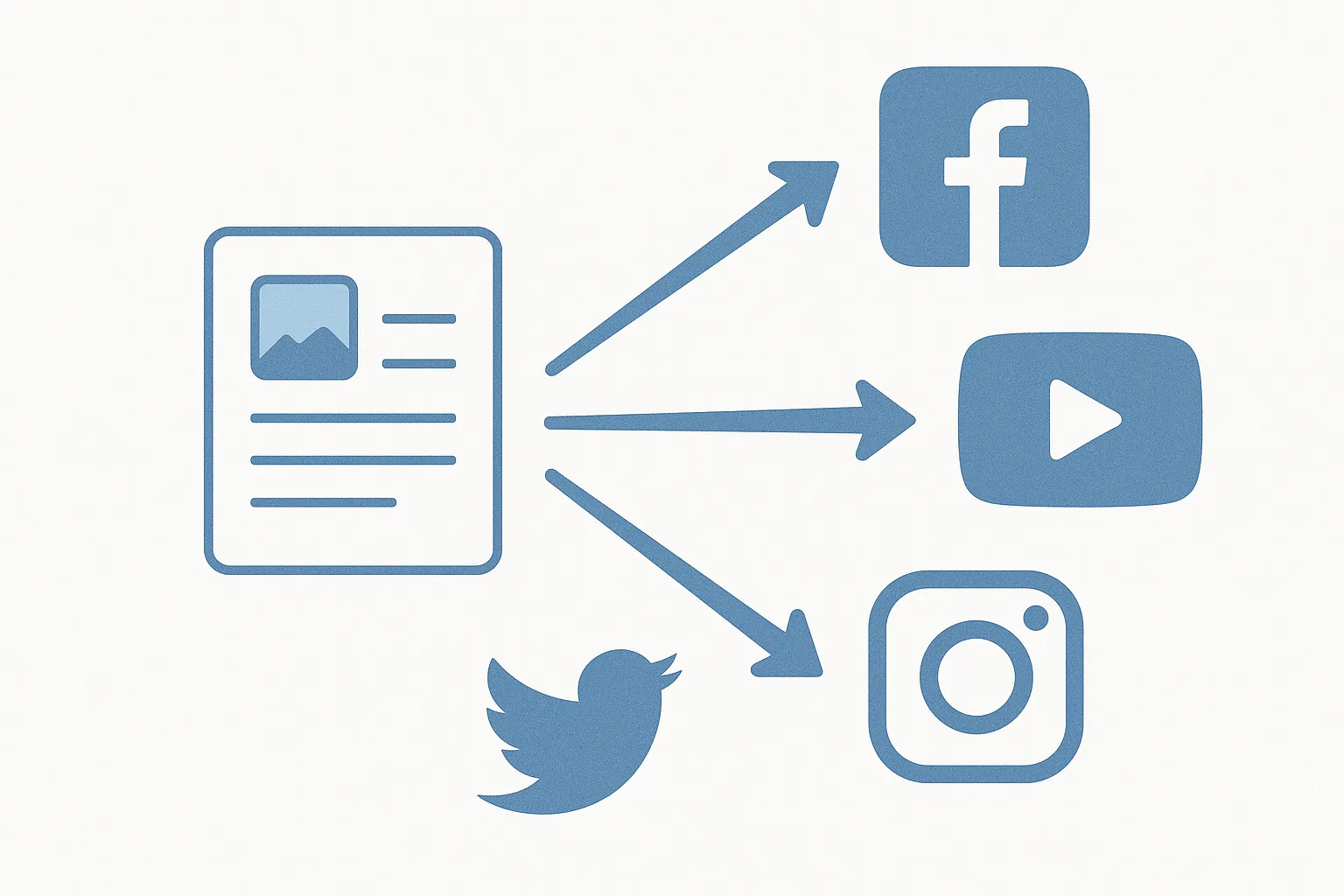
There is a better way. Cross-posting lets you create content once and publish it across every platform simultaneously. This guide covers everything you need to know about posting to all social media at once in 2026, from choosing the right tools to avoiding the mistakes that hurt your reach.
Key Takeaways
- Cross-posting saves 5-10 hours per week for creators and businesses active on multiple platforms
- The best cross-posting workflow involves connecting accounts via OAuth, creating content once, and publishing or scheduling across all platforms from a single dashboard
- Platform adaptation matters — the same core content should have slightly different captions, hashtags, and formatting for each platform
- Scheduling beats posting live because it lets you hit optimal times on each platform without being glued to your phone
- Engagement still requires manual effort — cross-posting handles distribution, but replying to comments and DMs remains a per-platform task
Why Does Cross-Posting Matter in 2026?
Cross-posting matters because your audience is fragmented across platforms, and manually posting to each one creates a bottleneck that limits your output and consistency. Most creators and businesses are active on three to seven platforms because that is where their audience lives. But each platform has its own app, its own upload flow, its own character limits, and its own quirks.
This fragmentation creates two core problems. First, there is massive time waste. Posting the same content to five platforms manually takes five times the effort. Second, inconsistency creeps in. When posting is tedious, you start skipping platforms or posting less frequently. The algorithm on every major platform rewards consistency, so when you drop off, your reach drops with you.
Cross-posting solves both problems. You create once and publish everywhere simultaneously. The math is simple: if you spend 30 minutes posting to one platform manually and you are active on six platforms, that is three hours per day just on distribution. A cross-posting tool cuts that to five minutes.
What Are the Real Benefits of Cross-Posting?
The immediate benefit is time savings, but the compounding benefits go much further. When distribution becomes effortless, you post more consistently. When you post more consistently, algorithms favor your content. When algorithms favor your content, you reach more people. When you reach more people, you grow faster. It is a virtuous cycle that starts with removing the friction of manual posting.
Here are the specific benefits creators and businesses report after adopting a cross-posting workflow:
- Time savings of 5-10 hours per week — This is the most cited benefit. Creators who previously spent an hour per day posting now batch their content in one session and schedule it for the entire week
- Increased posting frequency — When posting takes 30 seconds instead of 30 minutes, people naturally post more often. Higher frequency means more data points for algorithm learning and more opportunities for content to perform
- Better consistency across platforms — Instead of neglecting smaller platforms like Bluesky or Pinterest because they feel like extra work, creators maintain a presence everywhere their audience exists
- Improved content testing — Publishing the same content across platforms lets you see where it resonates most. A video that gets 500 views on Instagram might get 50,000 on TikTok, giving you valuable data about where to focus your energy
- Reduced burnout — Social media burnout is real, and a major cause is the repetitive mechanics of posting. Automating distribution lets creators focus their energy on the creative work they actually enjoy
How Does Cross-Posting Work in 2026?
Cross-posting in 2026 works through tools that connect to your social media accounts via OAuth (the standard secure authorization protocol) and publish content on your behalf. The process is straightforward, and most tools follow the same general workflow.
Step 1: Connect Your Social Media Accounts
The first step is linking your social media accounts to your cross-posting tool. This happens through OAuth, which is the same "Sign in with..." flow you use when logging into apps with your Google or Apple account. OAuth grants the tool permission to post on your behalf without ever sharing your actual passwords.
Most cross-posting tools in 2026 support the major platforms: Instagram, YouTube, TikTok, X (Twitter), Threads, Bluesky, and Pinterest. Some also support Facebook, LinkedIn, Reddit, Google Business Profile, Telegram, and Snapchat. The number of supported platforms varies by tool, so check coverage before committing.
The connection process typically takes under a minute per platform. You click "Connect," log in to the platform, authorize the tool, and the account appears in your dashboard. Some platforms like Instagram require a professional or business account for API posting.
Step 2: Create Your Post
With accounts connected, you create your post in the tool's composer. Write your caption and upload your media — photo or video — once. Then select which platforms you want to publish to. Some tools let you customize the caption per platform from the same screen, so you can write a longer caption for Instagram and a shorter one for X without creating separate posts.
Media handling has improved significantly in 2026. Most cross-posting tools now support presigned URL uploads, where the file goes directly to cloud storage and each platform receives the optimized version. This means faster uploads and better quality than the screenshot-and-reupload approach creators used years ago.
Step 3: Publish or Schedule
You have three publishing options with most tools. You can publish immediately to all selected platforms at once. You can schedule the post for a specific date and time in the future. Or you can add it to a queue, where predefined time slots automatically publish content in order.
Scheduling is the most powerful option because it lets you batch-create content during a focused session and have it publish at the optimal time for each platform throughout the week. Queue-based posting takes this further by removing the need to pick specific dates. You just set your time slots once (say, Monday, Wednesday, and Friday at 10 AM) and drop content into the queue. The next available slot publishes the next piece of content automatically.
What Should You Look for in a Cross-Posting Tool?
Not all cross-posting tools are equal, and picking the wrong one can create more friction than it removes. Here are the features that actually matter, ranked by importance.
Platform Coverage
The tool must support every platform you use. This sounds obvious, but many tools only cover two or three platforms, or they support some platforms for reading but not for posting. Before signing up, verify that the tool can actually publish (not just schedule) to Instagram, TikTok, YouTube, X, Threads, Bluesky, Pinterest, and any other platforms in your workflow. Tools like cross-post support seven major platforms from a single dashboard, which covers the needs of most creators and businesses.
Scheduling and Queue System
A good cross-posting tool should offer both specific-time scheduling and queue-based posting. Specific-time scheduling lets you pick exact dates and times for important posts like product launches or announcements. Queue-based posting lets you set recurring time slots and automatically fill them with content. Having both gives you maximum flexibility.
Media Support
Your tool should handle images, videos, and different aspect ratios without degrading quality. Video upload limits vary by platform — TikTok allows up to 10 minutes, Instagram Reels caps at 90 seconds, YouTube Shorts at 60 seconds. A good tool should enforce these limits during upload and either warn you or automatically trim content to fit.
Per-Platform Caption Customization
This is a feature many tools lack but that makes a significant difference in performance. You should be able to write one base caption and then customize it per platform. Instagram captions can be longer and include hashtags. X captions need to be concise. LinkedIn posts should be more professional. TikTok captions should include keywords for search. A tool that forces identical captions everywhere limits your effectiveness.
Simplicity
The entire point of cross-posting is saving time. If the tool requires a 30-minute onboarding tutorial, has a cluttered interface, or takes more clicks to publish than posting manually, it defeats the purpose. The best tools let you go from "open the app" to "content published on all platforms" in under two minutes.
Pricing
Many cross-posting tools charge per platform, per connected account, per team member, or per post. This makes costs unpredictable and creates a perverse incentive to post less. Look for tools with simple, predictable pricing that does not penalize you for being active across many platforms.
| Feature | Must Have | Nice to Have |
|---|---|---|
| 7+ platform support | ✓ | |
| Scheduling (specific time) | ✓ | |
| Queue/slot system | ✓ | |
| Video and image support | ✓ | |
| Per-platform captions | ✓ | |
| Calendar view | ✓ | |
| Bulk upload | ✓ | |
| Analytics/reporting | ✓ | |
| Draft support | ✓ | |
| Simple flat pricing | ✓ |
What Are the Platform-Specific Considerations for Cross-Posting?
While cross-posting saves enormous time, each platform has unique characteristics that affect how your content performs. Understanding these differences lets you cross-post strategically rather than blindly.
Instagram prioritizes vertical video (9:16 aspect ratio) for Reels, which is the format that reaches the most non-followers. Hashtags still matter for discoverability, though their role has shifted from discovery feeds to helping the algorithm categorize your content. Use five to ten relevant hashtags per post. Captions can be up to 2,200 characters, so take advantage of that space to add context, calls to action, or storytelling.
For cross-posting specifically, keep in mind that Instagram penalizes content with visible watermarks from other platforms. If your video has a TikTok watermark, Instagram's algorithm will suppress it. Always upload clean, watermark-free files.
TikTok
TikTok rewards short, punchy videos that hook viewers within the first three seconds. The algorithm measures watch-through rate (what percentage of viewers watch to the end) more heavily than any other metric. Trending sounds can significantly boost reach, but they cannot be added programmatically through posting tools — you need to add them in TikTok's native editor for full effect.
TikTok captions should be keyword-rich because TikTok functions as a search engine for younger users. Include relevant keywords that your target audience might search for. Video length sweet spot is 45 to 120 seconds in 2026.
YouTube Shorts
YouTube Shorts (under 60 seconds, vertical format) are excellent for cross-posting because they share the same 9:16 aspect ratio as TikTok and Instagram Reels. YouTube's algorithm has a wider discovery window than other platforms, meaning your Shorts can pick up views days or weeks after posting. Posting frequency matters more than exact timing on YouTube.
YouTube's main advantage is search longevity. Shorts that answer specific questions (how to tie a tie, best budget laptop 2026) continue driving views through YouTube search long after the initial push.
X (Twitter)
X is the most time-sensitive platform. A post's peak engagement window is roughly 15 to 30 minutes. If your audience is not online when you post, they will likely never see it. This makes scheduling to optimal times especially important on X.
Shorter captions perform better on X. The platform rewards concise, punchy statements and hot takes over long-form content. Thread-style content does not cross-post well — if you want to post threads, create them natively on X. For cross-posting, focus on single-post content with a strong hook.
Threads
Threads has a more conversational and casual tone than other platforms. It functions similarly to X but with a more relaxed vibe. Content that feels like a genuine thought or observation outperforms content that feels like marketing. Early morning posts tend to get more pickup as the platform's user base is still growing and forming engagement patterns.
Threads integrates tightly with Instagram, so having a strong Instagram presence helps your Threads content get distributed. Cross-posting your X content to Threads with minor tone adjustments is an efficient strategy.
Bluesky
Bluesky is a growing decentralized platform with an engaged early-adopter audience that skews toward tech-savvy professionals. The user base is smaller than other platforms, but engagement rates are disproportionately high. It is worth posting to even if your following is small because early movers on new platforms often see outsized growth as the platform scales.
Content that performs well on Bluesky tends to be thoughtful, opinionated, and conversational. The platform currently has a strong culture around tech, media, politics, and creative fields.
Pinterest is fundamentally different from every other platform on this list because it functions as a visual search engine rather than a social feed. Vertical images (2:3 ratio) with text overlays drive the most saves and clicks. Content on Pinterest has an incredibly long lifespan — a single pin can drive traffic to your website for months or even years.
For cross-posting, Pinterest requires the most adaptation. While you can share video pins (which work well for repurposed Reels and TikToks), static image pins with clear text overlays and keyword-rich descriptions typically outperform video. SEO-optimized pin descriptions are critical for Pinterest success.
How Should You Adapt Content for Each Platform?
The most effective cross-posting strategy is not about posting identical content everywhere. It is about posting the same core idea everywhere, adapted for each platform's culture and format. Here is a practical framework for adaptation.
Caption Adaptation
Start with a base caption that captures your message. Then adjust it for each platform:
- Instagram — Use your full caption length. Add a call to action (save this post, share with a friend). Include five to ten hashtags at the end or in a comment
- TikTok — Keep it short and keyword-rich. Write what someone would search for to find this content. Three to five hashtags
- YouTube Shorts — Title-style caption that clearly describes the video content. Keywords matter for YouTube search
- X — Punchy one-liner or question that stops the scroll. Skip the hashtags unless they are trending
- Threads — Casual, conversational version of your caption. Write like you are texting a friend
- Bluesky — Thoughtful, opinionated take on your topic. The audience values substance over style
- Pinterest — SEO-focused description with keywords your target audience would search for. Include your website URL
Media Adaptation
For video content, the 9:16 vertical format works across TikTok, Instagram Reels, YouTube Shorts, and Pinterest video pins. Always export clean versions without platform watermarks from your editing tool. If you edit in CapCut or a similar app, export once and upload the clean file to each platform through your cross-posting tool.
For image content, you may need multiple versions. Instagram favors square (1:1) or vertical (4:5) images for feed posts. Pinterest needs tall vertical (2:3) images. X performs well with horizontal (16:9) images. If creating image content for cross-posting, design your graphics at 1080x1350 pixels (4:5 ratio), which is a good compromise that works acceptably on most platforms.
Timing Adaptation
Each platform has different peak engagement hours. Instead of posting to all platforms at the same time, use scheduling to publish at the optimal time for each platform individually. General guidelines:
| Platform | Best Days | Best Times |
|---|---|---|
| Tue, Wed, Thu | 7-9 AM, 12-1 PM, 5-7 PM | |
| TikTok | Tue, Thu, Fri | 7-9 AM, 12-3 PM, 7-11 PM |
| YouTube | Fri, Sat, Sun | 12-3 PM, 5-8 PM |
| X (Twitter) | Mon, Tue, Wed | 8-10 AM, 12-1 PM |
| Threads | Weekdays | 8-10 AM, 6-8 PM |
| Bluesky | Tue, Wed, Thu | 9-11 AM, 1-3 PM |
| Sat, Sun | 8-11 PM |
What Is the Best Cross-Posting Workflow for Creators?
The most efficient cross-posting workflow follows a batch creation model. Instead of creating and posting content daily, you dedicate one or two focused sessions per week to content creation and scheduling. Here is a step-by-step workflow that works for solo creators and small teams.
Monday: Planning Session (30 Minutes)
Review last week's performance across all platforms. Identify which content performed best (highest engagement, most shares, most profile visits). Plan this week's content based on what worked. Decide on three to five pieces of content for the week, mapped to your content pillars.
Tuesday: Creation Session (2-3 Hours)
Batch-create all content for the week in one focused session. Film all videos back to back, write all captions, and prepare all images. Batching is significantly more efficient than creating content piecemeal because you stay in "creation mode" rather than switching between creating, editing, and publishing.
Tuesday or Wednesday: Scheduling Session (30-45 Minutes)
Upload all content to your cross-posting tool. Customize captions for each platform. Set publishing times based on platform-specific optimal windows. Review the calendar view to ensure consistent coverage throughout the week.
A tool like cross-post makes this step especially fast because you can select all your platforms, upload media once, and schedule to each platform's optimal time from a single interface.
Daily: Engagement (15-20 Minutes)
Even with automated distribution, you need to engage with your audience on each platform daily. Reply to comments, respond to DMs, and interact with content in your niche. This is the part of social media that cannot be automated and should not be.
What Are the Most Common Cross-Posting Mistakes?
Cross-posting is straightforward, but there are pitfalls that can reduce your effectiveness or even hurt your reach. Here are the mistakes to avoid.
Ignoring Platform Culture
Every platform has a distinct culture. What performs well on LinkedIn feels out of place on TikTok. What works on TikTok feels too casual for LinkedIn. While the core content can be the same, the tone and framing should adapt. A business tip might be presented as a polished insight on LinkedIn, a casual rant on X, and a fast-paced talking-head video on TikTok. Same message, different packaging.
Posting at the Same Time Everywhere
Each platform has different peak engagement hours, and your audience on each platform may live in different time zones. Posting simultaneously to all platforms at 10 AM means you are hitting the optimal time on maybe one platform and missing it on the rest. Use platform-specific scheduling to publish at the right time for each platform individually.
Never Engaging After Posting
Cross-posting handles distribution, but it does not handle community building. If you schedule posts and never return to the platform, you miss comments, DMs, and opportunities to build relationships with your audience. The algorithm on every platform tracks your engagement behavior and rewards accounts that actively participate in conversations.
Cross-Posting Content With Watermarks
This is one of the most damaging mistakes. Instagram explicitly suppresses content with TikTok watermarks. TikTok deprioritizes content with Instagram or YouTube watermarks. Always upload clean, watermark-free content from your video editor. Never screen-record content from one platform to upload to another.
Not Adapting Video Length
Instagram Reels caps at 90 seconds. YouTube Shorts caps at 60 seconds. TikTok allows up to 10 minutes. A 2-minute video that works perfectly on TikTok will not upload to YouTube Shorts and will need to be trimmed for Instagram Reels. Plan your content with these limits in mind, or create at the shortest common length (60 seconds) to ensure compatibility everywhere.
Posting Too Much Identical Content
If someone follows you on three platforms and sees the exact same post three times in one hour with identical captions, it feels spammy. Stagger your publishing times across platforms (post to TikTok Monday morning, Instagram Monday evening, YouTube Tuesday afternoon) and customize captions so the content feels native to each platform rather than copy-pasted.
Can You Cross-Post and Still Grow on Each Platform?
A common concern is that cross-posting produces generic content that does not perform well on any individual platform. This is a valid concern if you approach cross-posting as copy-pasting, but it is not a problem if you approach it as strategic repurposing.
The evidence is clear: the vast majority of successful multi-platform creators cross-post the bulk of their content. They create one piece of core content and adapt it for each platform. The adaptation does not need to be dramatic — different captions, slightly different hooks, platform-appropriate formatting. These small adjustments take five minutes per platform and make the difference between content that feels native and content that feels repurposed.
The creators who struggle with cross-posting are the ones who make zero adaptations and the ones who try to create entirely unique content for every platform. The sweet spot is in the middle: same core idea, platform-specific packaging.
How Does Cross-Posting Fit Into a Broader Content Strategy?
Cross-posting is not a content strategy by itself. It is a distribution strategy that amplifies whatever content strategy you have. Your content strategy defines what you create, who it is for, and why they should care. Cross-posting ensures that content reaches every audience you have built, on every platform they use.
A complete content strategy with cross-posting at its core looks like this:
- Define your content pillars — Three to five recurring themes that your audience values and that align with your brand or expertise
- Create core content — Produce one to two substantial pieces of content per week (videos, blog posts, or detailed posts)
- Break it down — Extract three to five smaller pieces from each core content piece for short-form platforms
- Cross-post with adaptation — Publish to all platforms with per-platform caption and formatting adjustments
- Engage on each platform — Spend 15 to 20 minutes daily responding to comments and participating in conversations
- Analyze and iterate — Review performance weekly. Double down on what works. Drop what does not
What Is the Future of Cross-Posting?
The trend in social media is toward more platforms, not fewer. Bluesky, Threads, and other emerging platforms continue to gain users. For creators and businesses, this means the need for efficient cross-posting will only grow. Manually managing seven or more platforms is already unsustainable — managing ten or twelve will be impossible without tools.
AI-assisted caption adaptation is already appearing in some tools, automatically rewriting your base caption to match each platform's tone and length requirements. Automated video reformatting (cropping horizontal video to vertical, trimming to platform-specific length limits) is becoming standard. These advances will make cross-posting even more seamless in the coming years.
The fundamental value proposition will not change: create once, publish everywhere, focus your energy on creating great content rather than on the mechanics of distribution.
Frequently Asked Questions
Does cross-posting hurt your reach on individual platforms?
No, as long as you adapt content for each platform. Posting identical content with watermarks from another platform will hurt your reach. But posting the same core content with platform-appropriate captions, clean media files, and optimized formatting performs just as well as native content. Instagram, TikTok, and YouTube do not penalize content for existing on other platforms — they penalize low-quality uploads and visible watermarks.
How many platforms should you cross-post to?
Post to every platform where you have an audience or want to build one, but only if you can maintain engagement on each. For most creators and small businesses, three to five platforms is the sweet spot. If you are just starting out, begin with two platforms and expand as you build a workflow. The platforms you choose should match where your target audience spends their time.
Is it better to post natively or use a cross-posting tool?
For most use cases, a cross-posting tool is more efficient and produces equivalent results. The main exception is when you want to use platform-specific features that require native posting, such as TikTok trending sounds, Instagram collaborative posts, or YouTube community posts. For standard video and image posts with captions, a cross-posting tool like cross-post handles distribution faster without any quality loss.
Can you schedule posts to all platforms for free?
Some tools offer free tiers with limited features, but most robust cross-posting tools require a paid subscription. The cost is typically far less than the value of time saved. If you value your time at even $20 per hour and a cross-posting tool saves you five hours per week, that is $400 per month in time savings. Most tools cost a fraction of that.
What happens if a cross-posted piece of content fails on one platform but succeeds on another?
This happens frequently and is actually one of the benefits of cross-posting. A video that gets 200 views on Instagram might get 50,000 on TikTok, or vice versa. This gives you data about which platforms are best suited for different types of content. Over time, you can adjust your strategy to create more of what works on each platform while still cross-posting as your default distribution method.
Should you post to all platforms at the same time?
No. Each platform has different peak engagement hours, and your audience on each platform may be in different time zones. Use scheduling to publish at the optimal time for each platform individually. This typically means staggering your posts throughout the day or week rather than publishing simultaneously.
How do you handle different video length limits across platforms?
The safest approach is to create content at the shortest common length limit. YouTube Shorts caps at 60 seconds, Instagram Reels at 90 seconds, and TikTok at 10 minutes. If you create a 60-second video, it works on all three platforms. If you create longer content, you will need to create trimmed versions for platforms with shorter limits. Some creators film with natural break points so they can easily create both long and short versions from the same footage.
Do you need to post different content on each platform to grow?
No. The overwhelming majority of successful multi-platform creators cross-post most of their content. The key is making small adaptations (different captions, platform-appropriate hashtags, clean media without watermarks) rather than creating entirely unique content for each platform. Creating unique content for every platform is a full-time job and is not necessary for growth. Cross-post your core content and reserve native-only content for platform-specific features like Instagram Stories, TikTok duets, or X threads.
Ready to simplify your social media?
Post to Instagram, YouTube, TikTok, X, Threads, Pinterest, and Facebook from one dashboard.
Get Started Free →