Should you spend money on social media ads or focus on organic growth? It's one of the most common questions in digital marketing, and the answer has changed significantly over the past few years as organic reach has declined and ad platforms have matured.
Here's a clear-eyed comparison of organic vs paid social media marketing in 2026 — when each works, how to combine them, and how to decide where to put your budget.
Key Takeaways
- Organic social media builds trust, community, and long-term assets — it costs time, not money, and compounds over time
- Paid social media buys immediate reach, precise targeting, and measurable ROI — it delivers results fast but stops the moment you stop paying
- The best strategy combines both — use organic to prove what works, then use paid to amplify your top performers
- Budget allocation depends on your stage — early-stage businesses should focus on organic; established businesses should split strategically
- Each platform's ad system has different strengths — Meta for targeting, TikTok for cost-efficiency, LinkedIn for B2B, Pinterest for purchase intent
- Test creative organically before spending money — your organic feed is a free testing ground for ad content
What Is the Difference Between Organic and Paid Social Media?
Organic social media is everything you post without paying to promote it. Your regular posts, stories, reels, and community engagement. Your audience sees it based on the algorithm's decision to show it to them. You don't control who sees it or how many people see it — that's entirely up to the platform.
Paid social media is content you pay to put in front of a specific audience. This includes boosted posts, targeted ad campaigns, sponsored content, and retargeting ads. You define the audience, set the budget, and the platform guarantees the reach. You're essentially renting attention from the platform.
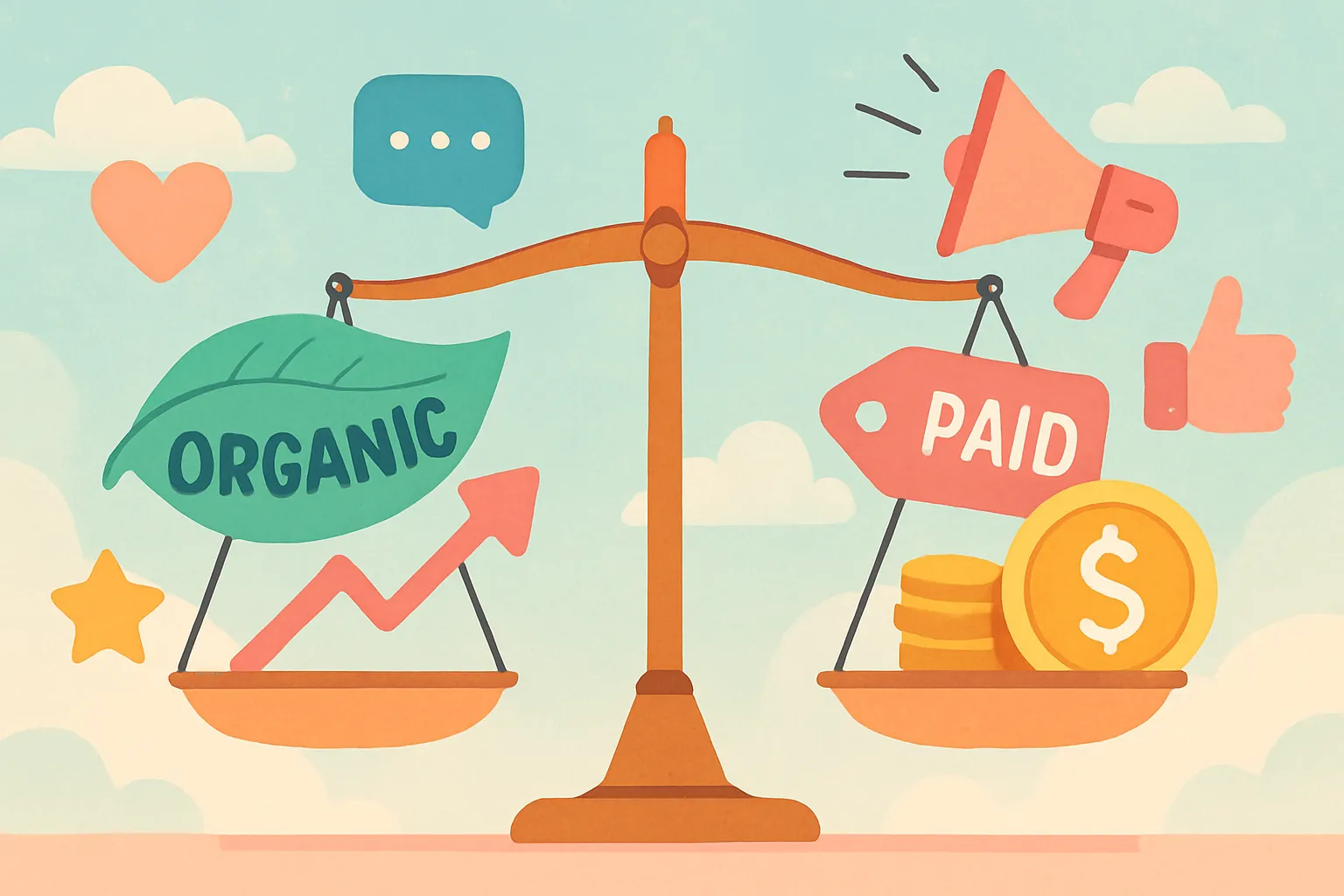
The simplest way to think about it: organic builds trust over time. Paid buys attention right now. Neither is inherently better — they serve different purposes and work best when used together strategically.
| Factor | Organic Social Media | Paid Social Media |
|---|---|---|
| Cost | Free (time investment only) | Requires advertising budget |
| Reach | Limited by algorithm (typically 2-10% of followers) | Unlimited (determined by budget) |
| Targeting | Algorithm decides who sees content | Precise audience selection |
| Speed of results | Slow (months to build traction) | Fast (hours to days) |
| Trust building | Strong (earned attention) | Weaker (bought attention) |
| Longevity | Content works indefinitely | Stops when budget runs out |
| ROI measurement | Indirect (brand awareness, community) | Direct (cost per click, conversion rate) |
| Best for | Brand building, community, credibility | Lead generation, sales, rapid scaling |
What Are the Benefits of Organic Social Media Marketing?
Organic marketing builds the foundation that everything else sits on. Without a solid organic presence, even the best ad campaigns underperform because people who see your ad will visit your profile — and if it's empty or inconsistent, they won't convert. Here's what organic does well:
How Does Organic Build Long-Term Trust and Credibility?
When someone discovers your profile through a recommendation, a search, or the For You page and sees months of consistent, valuable content, that builds credibility no ad can replicate. Organic content demonstrates expertise over time. It shows that you're not just showing up when you want to sell something.
This trust effect is measurable. Studies consistently show that consumers trust organic social media content more than paid advertisements. When a brand publishes helpful content consistently — tutorials, behind-the-scenes, expert insights, genuine customer stories — audiences develop a relationship with that brand that transcends any single transaction.
The compound effect is particularly powerful: a new follower who discovers you today can scroll through months of content and build trust in minutes. That backlog of organic content does sales work for you 24/7 without any additional spend.
Why Is Organic Better for Community Building?
Organic is where relationships happen. Replying to comments, engaging with followers' content, starting conversations, hosting live Q&As, sharing behind-the-scenes moments — this is how you turn passive followers into active advocates. Paid ads don't build community. They drive transactions.
The difference matters because community creates compounding returns:
- Community members become repeat customers without additional acquisition costs
- They create user-generated content that acts as free marketing
- They defend your brand during controversies or negative press
- They refer friends and colleagues, driving word-of-mouth growth
- They provide honest feedback that helps you improve your product or service
None of this happens through paid media alone. A customer acquired through an ad might buy once. A community member acquired through consistent organic value might buy ten times and bring five friends.
How Does Organic Content Work as a Long-Term Asset?
A great organic post can drive traffic and generate followers for months. A YouTube video can get views for years. Pinterest pins stay discoverable indefinitely. SEO-optimized blog posts shared on social media continue generating traffic long after publishing. Organic content compounds over time in a way that paid campaigns fundamentally cannot — when you stop paying, ads stop running. Good organic content keeps working.
Consider the math: if you publish 3 pieces of organic content per week for a year, you have 156 pieces of content that can be discovered by new audiences at any time. Each one is a potential entry point to your brand. After two years, you have 312 assets working for you simultaneously. No ad budget can replicate this compound effect.
What About the Cost Advantage of Organic?
Organic social media is free in terms of ad spend. It costs time — which is absolutely not nothing — but for bootstrapped businesses, solo creators, and anyone who can't afford to spend hundreds or thousands on ads, organic is the only viable starting point.
Even for businesses with ad budgets, the cost advantage of organic matters. Every sale that comes through organic content has a $0 customer acquisition cost from an advertising perspective. If your organic content drives 50% of your social media revenue, you've effectively halved your marketing costs compared to a paid-only strategy.
The time investment is real, though. Creating quality organic content takes 5 to 15 hours per week depending on the format and frequency. But tools that streamline the process — content scheduling, batch creation workflows, cross-platform publishing through tools like cross-post — can reduce this time significantly.
What Are the Benefits of Paid Social Media Marketing?
Paid social media solves problems that organic can't, no matter how good your content is. If organic is the long game, paid is the fast lane — and sometimes you need the fast lane.
How Does Paid Provide Immediate Reach and Scale?
Organic reach on most platforms has been declining for years. On Facebook, organic posts reach roughly 2 to 5% of your followers. On Instagram, it's slightly better but still limited. On LinkedIn, organic reach is better but declining. Paid removes that ceiling entirely. You can reach 100,000 people today if you have the budget.
This isn't just about vanity reach — it's about speed to results. A new product launch, a time-sensitive promotion, a seasonal campaign — all of these have deadlines. Organic growth doesn't care about your deadlines. Paid gives you results on your schedule.
The scale potential is also worth noting. If your organic content reaches 5,000 people per post, that's your ceiling unless something goes viral. Paid lets you dial reach up or down based on your goals and budget. Want to reach 50,000 people this week? Set the budget. Want to reach 500,000 for a launch? Scale up. This controllability is something organic will never offer.
What Kind of Targeting Does Paid Social Media Offer?
Platforms like Meta, TikTok, and LinkedIn let you target audiences by age, location, interests, behavior, job title, purchase history, and more. Organic posts go wherever the algorithm sends them. Paid posts go exactly where you tell them to.
The targeting capabilities have become remarkably sophisticated:
- Demographic targeting — Age, gender, location, language, education level, relationship status
- Interest-based targeting — Hobbies, favorite brands, media consumption habits, purchase interests
- Behavioral targeting — Purchase behavior, device usage, travel habits, life events (just moved, just got engaged, new job)
- Retargeting — Show ads specifically to people who visited your website, watched your videos, or engaged with previous posts
- Lookalike audiences — Find new people who resemble your existing customers or email subscribers
- Custom audiences — Upload your email list or customer database and target those specific people
This precision means every dollar works harder. Instead of hoping the algorithm shows your content to the right people, you define exactly who "the right people" are and guarantee they see your message.
How Do You Measure ROI on Paid Social Media?
Every dollar spent on paid social can be tracked to impressions, clicks, conversions, and revenue. You know your cost per click, cost per acquisition, and return on ad spend. This measurability is one of paid's greatest strengths — you can see exactly what's working and what isn't, then optimize in real time.
Key metrics to track for paid campaigns:
- CPC (Cost Per Click) — How much you pay for each click to your website or landing page
- CPM (Cost Per Mille) — How much you pay per 1,000 impressions
- CPA (Cost Per Acquisition) — How much you pay for each conversion (sale, signup, lead)
- ROAS (Return on Ad Spend) — Revenue generated divided by ad spend. A ROAS of 4x means you earn $4 for every $1 spent
- CTR (Click-Through Rate) — Percentage of people who see your ad and click. Industry average is 0.9 to 1.5% depending on platform
- Conversion rate — Percentage of people who click and then complete the desired action
Organic ROI, by comparison, is much harder to quantify — how do you measure the value of "brand trust" or "community loyalty"? Both matter, but paid gives you the numbers to prove it.
When Is Speed the Deciding Factor?
Launching a new product? Running a time-sensitive promotion? Filling seats for an event next week? Paid social gives you results in hours, not months. Organic growth is slow by nature — building an audience takes consistent effort over extended periods. If you need results now, paid is the answer.
The speed advantage is particularly valuable for:
- Product launches where timing creates urgency
- Seasonal promotions (Black Friday, holiday sales, back-to-school)
- Event registrations with fixed deadlines
- Testing new markets or audiences before investing in organic
- Competing for attention during high-traffic periods
When Should I Focus on Organic Social Media?
Organic-first strategies make sense when:
- You're just starting out. Build your content library, find your voice, and understand your audience before spending money on ads. Running ads to a profile with 5 posts and no clear identity wastes money — people who click will visit your profile and leave
- Your budget is limited. If you can't afford to spend at least a few hundred dollars per month consistently for at least 2 to 3 months, organic is your best bet. Ad campaigns need sustained investment to optimize
- You're building a personal brand. People follow people for their personality and expertise. Ads can accelerate awareness, but the core content needs to be organic and authentic. You can't build a personal brand through ads alone
- You're in a niche with low competition. If the search results and feeds aren't saturated, organic content can dominate discovery without any paid boost
- You're playing the long game. If you're building a brand that will exist for years, organic content creates the foundation that paid amplifies later. Spending on ads without this foundation is like watering seeds you haven't planted
- Your industry relies heavily on trust. Healthcare, financial advice, education, consulting — these fields require credibility that only consistent organic content can build. An ad might get a click, but organic content builds the trust needed for someone to hire you or buy from you
- Your product has a long sales cycle. If customers need weeks or months to make a decision (B2B software, high-ticket services, luxury goods), organic content nurtures them through that process better than a one-time ad impression
When Should I Invest in Paid Social Media?
Paid social makes sense when:
- You have a proven offer. Don't run ads until you know your product or service converts. Ads amplify — they don't fix a broken offer. If your landing page converts at 0.5%, sending more traffic to it through ads just means more wasted budget. Fix the conversion first, then scale with paid
- You need leads or sales quickly. Product launches, seasonal promotions, event registrations — anything time-sensitive benefits from paid reach. Organic can't be rushed
- You've hit an organic plateau. If your organic reach has flatlined despite good content, paid can break through the ceiling. This is common on Facebook and increasingly on Instagram
- You have data to target with. Retargeting website visitors, lookalike audiences from your email list, or targeting based on competitor audiences — these high-ROI strategies only work with paid
- You can sustain it. Ads need at least 2 to 4 weeks to optimize. Starting and stopping campaigns wastes money because the algorithm needs time to learn who responds to your ads. Plan for at least 60 to 90 days of continuous spend
- Your organic content has proven what works. If you know which topics, formats, and hooks get the best organic engagement, you can create ads based on those proven concepts and dramatically improve your ad performance
- You're entering a new market. Expanding to a new geographic region, demographic, or platform where you have no organic presence? Paid gets you visibility immediately while you build organic presence in parallel
How Do I Combine Organic and Paid Social Media?
The most effective approach in 2026 is using both strategically. Social media ad spending continues to grow year over year, but the brands getting the best returns are the ones combining paid with strong organic foundations. Here's exactly how to integrate them:
How Do I Boost My Best Organic Content?
This is the highest-ROI paid strategy available, and it's where most businesses should start with paid. Instead of creating ads from scratch, identify your top-performing organic posts and boost them. You already know the content resonates — you've proven it with real engagement. Putting money behind proven content dramatically improves your return on ad spend compared to untested creative.
The process is straightforward:
- Review your organic posts from the past 2 weeks
- Identify the top 2 to 3 by engagement rate (not just total engagement — rate matters more)
- Boost those posts with a modest budget ($10 to $50 per post depending on your overall budget)
- Target an audience that matches the demographics of your organic engagers
- Let the boost run for 3 to 7 days and track performance
- Double down on boosts that deliver strong results; pause ones that don't
This strategy works because you're eliminating the biggest variable in paid advertising: creative risk. The content is already proven. You're just paying to show it to more of the right people.
How Do I Use Organic for Top of Funnel and Paid for Bottom?
Let organic content handle awareness and trust-building: educational posts, entertaining videos, community engagement, thought leadership. Use paid for the conversion layer: retargeting people who've visited your website, promoting a specific offer to warm audiences, or driving email signups from lookalike audiences.
This funnel approach looks like:
- Top of funnel (Organic): Create valuable content that attracts new followers and builds awareness. Tutorials, tips, insights, entertaining content, behind-the-scenes. Goal: attract and educate
- Middle of funnel (Organic + Paid): Nurture your audience with deeper content — case studies, webinars, detailed guides. Use paid retargeting to reach people who engaged with top-of-funnel content but haven't converted yet
- Bottom of funnel (Paid): Direct-response ads targeting warm audiences — retarget website visitors, email subscribers, or highly engaged followers with specific offers, product promotions, or lead magnets. Goal: convert
How Do I Test Creative Organically Before Running Ads?
Before spending on an ad campaign, post the creative organically. If it gets strong engagement, it'll likely perform well as an ad. If it falls flat, iterate before you spend money. Your organic feed is a free testing ground.
This testing process saves significant ad budget:
- Post 5 to 10 organic variations of your ad concept over 1 to 2 weeks
- Track which gets the highest engagement rate, save rate, and share rate
- Take the top 2 performers and create ad versions of them
- Run A/B tests with the ad versions to further optimize
- Scale the winner
Brands that test organically before running ads report 20 to 40% lower cost per acquisition because they're starting with creative that's already been validated by real audience behavior.
How Should I Allocate My Social Media Budget Between Organic and Paid?
If you're spending money on social media marketing, here's a practical framework based on total monthly budget:
| Monthly Budget | Organic vs Paid Split | Recommended Strategy |
|---|---|---|
| $0 (time only) | 100% organic | Focus entirely on content creation, community engagement, and organic growth. Use free scheduling tools |
| Under $500 | 90% organic / 10% paid | Use the budget to boost 1-2 top-performing posts per week. Focus remaining effort on organic content quality |
| $500 to $2,000 | 60% organic / 40% paid | Run one continuous campaign plus boosted posts. Test retargeting if you have website traffic |
| $2,000 to $5,000 | 40% organic / 60% paid | Run multiple ad campaigns, full retargeting funnel, and A/B creative testing alongside consistent organic |
| Over $5,000 | 30% organic / 70% paid | Sophisticated multi-platform ad strategy with dedicated creative, multiple audience segments, and full funnel approach |
Important note: "organic effort" in this context includes the time spent creating content, engaging with the community, and managing your social presence. Even at higher budgets where paid dominates the spending split, organic content creation should never stop — it feeds your ad creative and maintains the trust that makes ads convert.
How Do Ad Platforms Differ for Paid Social Media?
Not all paid social platforms deliver the same results. Choosing the right platform depends on your audience, your goals, and your budget. Here's a detailed comparison:
Meta (Instagram and Facebook) Ads
Best for broad consumer targeting. Meta has the most mature ad platform with the most optimization features. Their pixel tracking and conversion API provide detailed attribution. Strongest for e-commerce and lead generation. Retargeting capabilities are the best in the industry. Average CPC ranges from $0.50 to $2.00 depending on the industry and competition.
TikTok Ads
Lower cost per impression than Meta in most niches. Best for reaching younger audiences (18 to 34). Creative matters more than targeting on TikTok — entertaining, native-feeling ads outperform polished ones. TikTok Shop integration makes it increasingly strong for direct product sales. Average CPC is typically 30 to 50% lower than Meta for comparable audiences.
YouTube Ads
Best for long-form brand awareness and consideration-stage marketing. Higher cost per view but higher intent — people are in "watching" mode. Great for considered purchases where the customer needs education (software, financial products, courses). Skippable in-stream ads mean you only pay when someone watches at least 30 seconds, which self-selects for interested viewers.
X/Twitter Ads
Best for promoting content and driving conversation. Lower competition in most niches means lower costs. Strong for B2B when combined with keyword and interest targeting. Event-based targeting (reaching people talking about specific conferences, launches, or industry events) is uniquely powerful on X.
Pinterest Ads
Best for products with visual appeal. High purchase intent — people use Pinterest to plan purchases, which means they're further along in the buying journey than on most other platforms. Longer ad lifespan than other platforms — promoted pins can continue driving traffic for months. Strongest categories: home, fashion, food, beauty, wedding, and DIY.
LinkedIn Ads
Most expensive per click ($3 to $8+ depending on industry) but best for B2B targeting. Job title, company size, industry, seniority level — no other platform offers this level of professional targeting. Worth it when your customer lifetime value justifies the cost. A B2B software company with a $10,000 annual contract value can easily afford $50 to acquire a qualified lead on LinkedIn.
| Platform | Best For | Avg CPC | Audience Strength | Creative Style |
|---|---|---|---|---|
| Meta (IG/FB) | E-commerce, lead gen | $0.50-$2.00 | Broadest targeting options | Polished to authentic |
| TikTok | Young audiences, products | $0.30-$1.00 | 18-34 demographic | Native, entertaining |
| YouTube | Brand awareness, education | $0.10-$0.30/view | High-intent viewers | Informative, longer form |
| X/Twitter | Content promotion, B2B | $0.25-$1.50 | Real-time, interest-based | Conversational |
| Visual products, planning | $0.10-$1.50 | High purchase intent | Aspirational, visual | |
| B2B, professional services | $3.00-$8.00+ | Professional targeting | Professional, value-driven |
What Are the Most Common Mistakes With Organic Social Media?
Even with the right strategy, these organic mistakes can sabotage your results:
- Inconsistency. Posting daily for two weeks, then vanishing for a month. Algorithms and audiences both reward consistency. Three posts per week, every week, beats daily posting that burns you out in a month
- Ignoring engagement. Posting content but never replying to comments, DMs, or mentions. Organic social media is social — if you treat it as a broadcast channel, you'll never build the community that drives organic reach
- No clear call to action. If every post ends without telling the audience what to do next, you're leaving results on the table. Follow, save, share, comment, visit the link — tell people what you want them to do
- Chasing virality over value. Creating content designed to go viral rather than content designed to serve your specific audience. Viral posts bring vanity metrics. Valuable posts bring customers
- Not repurposing content. Creating every post from scratch when your best-performing content could be adapted, updated, and reshared across platforms. A single blog post can become a carousel, a video, a thread, and a series of story slides
- Platform sprawl without strategy. Trying to maintain active organic presences on 6 platforms when you only have bandwidth for 2. It's better to be great on 2 platforms than mediocre on 6. Use a cross-posting tool like cross-post to extend your reach to additional platforms without multiplying your workload
What Are the Most Common Mistakes With Paid Social Media?
Paid social media mistakes are more expensive because they directly waste budget:
- Running ads without a proven offer. If your product doesn't sell organically, ads won't fix that. Ads amplify what already works. Test your offer, landing page, and pricing with organic traffic first
- Too broad targeting. Targeting "women 18-65 in the United States" wastes money on people who will never buy. Narrow your targeting to the people most likely to convert based on interests, behaviors, and demographics
- Not testing creative. Running a single ad version and hoping it works. Always test at least 3 to 5 creative variations — different hooks, different visuals, different copy angles — and let the data tell you what performs
- Killing campaigns too early. Pulling the plug after 3 days because you haven't seen results. Most ad platforms need 5 to 7 days and 50+ conversions to optimize delivery. Premature optimization is a form of waste
- Ignoring landing page quality. Your ad is only half the equation. If the landing page is slow, confusing, or doesn't match the ad's promise, you'll pay for clicks that never convert. Always optimize the full journey from ad to conversion
- No retargeting strategy. Only running cold ads without retargeting people who've already shown interest. Retargeting typically delivers 3 to 10 times higher ROI than cold campaigns because you're reaching people who already know you
- Neglecting the organic profile. Running great ads to a profile with no organic content. People who see your ad will check your profile. If it's empty, they won't trust you enough to buy
How Do I Track the ROI of Organic vs Paid?
Tracking paid ROI is straightforward — the platforms give you the data. Tracking organic ROI requires a different approach:
Tracking Organic ROI
- UTM parameters on all shared links. Tag every link you share organically with UTM parameters so you can see organic social traffic in your website analytics
- Follower-to-customer conversion rate. Track how many followers eventually become customers over time. This is your organic conversion pipeline metric
- Engagement-to-revenue correlation. Measure whether increases in organic engagement correlate with increases in revenue over quarterly periods
- Customer acquisition cost (CAC) comparison. Compare the all-in cost of acquiring a customer through organic (content creation time valued at your hourly rate) versus paid (ad spend plus creative cost). Many businesses find organic CAC is 50 to 75% lower than paid CAC
- Brand search volume. Track whether your brand name searches on Google increase as your organic social presence grows. This is a proxy for brand awareness driven by organic content
Tracking Paid ROI
- Platform attribution. Use each platform's conversion tracking (Meta Pixel, TikTok Pixel, LinkedIn Insight Tag) to track conversions from ads
- ROAS by campaign. Calculate return on ad spend for each campaign to identify your most profitable advertising strategies
- Blended CAC. Calculate your total marketing spend (organic time + paid budget) divided by total new customers to get a blended customer acquisition cost
How Does the Organic vs Paid Split Change by Industry?
Different industries have different optimal splits between organic and paid. The right ratio depends on your sales cycle, customer lifetime value, and the role trust plays in the buying decision.
| Industry | Recommended Split | Reasoning |
|---|---|---|
| E-commerce (low ticket) | 40% organic / 60% paid | Quick purchase decisions benefit from paid reach; organic builds brand affinity for repeat purchases |
| E-commerce (high ticket) | 50% organic / 50% paid | Higher consideration purchases need trust-building organic content alongside targeted paid campaigns |
| SaaS / Software | 60% organic / 40% paid | Long sales cycles require educational organic content; paid handles lead generation and retargeting |
| Professional services | 70% organic / 30% paid | Trust and authority are paramount; organic content demonstrates expertise, paid amplifies reach |
| Personal brands / Creators | 80% organic / 20% paid | Authentic organic content IS the product; paid only for specific promotions or launches |
| Local businesses | 60% organic / 40% paid | Organic builds community; paid targets local audiences with geo-specific offers |
The Verdict: Organic vs Paid Social Media in 2026
It's not organic versus paid. It's organic and paid, used strategically for different purposes. Organic builds the brand. Paid amplifies it. Start with organic, prove your content works, then use paid to scale what's already resonating.
The specific ratio depends on your business stage, budget, and goals. But the principle is universal: organic without paid leaves growth on the table. Paid without organic lacks the trust foundation that makes advertising convert. Together, they create a marketing engine that compounds over time.
Paid advertising captures attention. Organic marketing builds belief. The brands that win in 2026 do both — strategically, consistently, and in proportion to their goals.
Frequently Asked Questions
Can I Grow on Social Media Without Spending Any Money on Ads?
Yes, absolutely. Millions of creators and businesses have built significant followings and revenue streams through organic content alone. It takes longer than paid growth, but the audience you build organically tends to be more engaged, more loyal, and more likely to convert. The key is consistency, quality content, and genuine community engagement. Many successful creators never spend a dollar on ads — they invest time instead of money.
How Much Should a Small Business Spend on Social Media Ads?
Start with 5 to 10% of your monthly revenue as a social media ad budget. If you're generating $10,000 per month, start with $500 to $1,000. This gives you enough budget to test, optimize, and see meaningful results. Don't spend money you can't afford to lose for 60 to 90 days — ad campaigns need time to optimize and early results rarely reflect long-term performance.
Is Organic Reach Really Dead on Facebook?
Not dead, but significantly reduced. The average Facebook page reaches 2 to 5% of its followers with organic posts. Facebook Groups perform better, with higher organic visibility for group content. Video content, especially Reels, gets better organic distribution than static posts. But if Facebook is your primary platform and you need reach beyond your existing followers, paid is essentially required.
Should I Boost Posts or Run Full Ad Campaigns?
Start with boosting your top organic posts. It's simpler, lower-risk, and leverages content that's already proven to work. Graduate to full ad campaigns when you have a specific conversion goal (lead generation, sales, app installs), need advanced targeting options, or want to run multi-stage funnels with retargeting. Boosting is best for awareness and engagement. Full campaigns are best for direct response.
How Long Does It Take to See Results From Organic Social Media?
Expect 3 to 6 months of consistent posting before you see meaningful organic traction. The first month is building your content foundation. Months 2 and 3 are when the algorithm starts understanding your audience. Months 4 through 6 are when compounding kicks in and growth accelerates. Some niches are faster, some are slower, but under 3 months of consistent effort is rarely enough time to judge whether organic is working.
What's the Best Platform for Organic Reach in 2026?
TikTok and YouTube Shorts still offer the highest organic reach potential for new accounts because their algorithms prioritize content quality over follower count. Pinterest has the longest-lasting organic reach — pins can drive traffic for months or years. LinkedIn has strong organic reach for professional content. Instagram's organic reach is moderate but improving with Reels. Facebook has the lowest organic reach for pages, making it the most dependent on paid.
Can Paid Ads Hurt My Organic Reach?
There's no evidence that running paid ads directly reduces your organic reach. However, if you start relying entirely on paid and stop posting organic content, your organic presence will naturally decline. The algorithm rewards active, consistent accounts. Additionally, if your paid ads drive followers who aren't genuinely interested in your content, your engagement rate can drop, which may indirectly reduce organic reach for future posts.
How Do I Know If My Ad Spend Is Being Wasted?
Watch for these warning signs: CPC is above industry average with no clear reason, your click-through rate is below 0.5%, your landing page bounce rate is above 80%, you're getting clicks but zero conversions, or your cost per acquisition is higher than the customer's first purchase value. If any of these apply, pause the campaign, diagnose the issue (creative, targeting, landing page, or offer), fix it, and then resume.
Ready to simplify your social media?
Post to Instagram, YouTube, TikTok, X, Threads, Pinterest, and Facebook from one dashboard.
Get Started Free →